The Style Guide · Coastal Maximalism
Coastal Maximalism: How to Get Marina's Seashell Study Look
Marina proves you can work from home without forgetting you live near the water—even if that water is just your bathtub.
What is Coastal Maximalism?
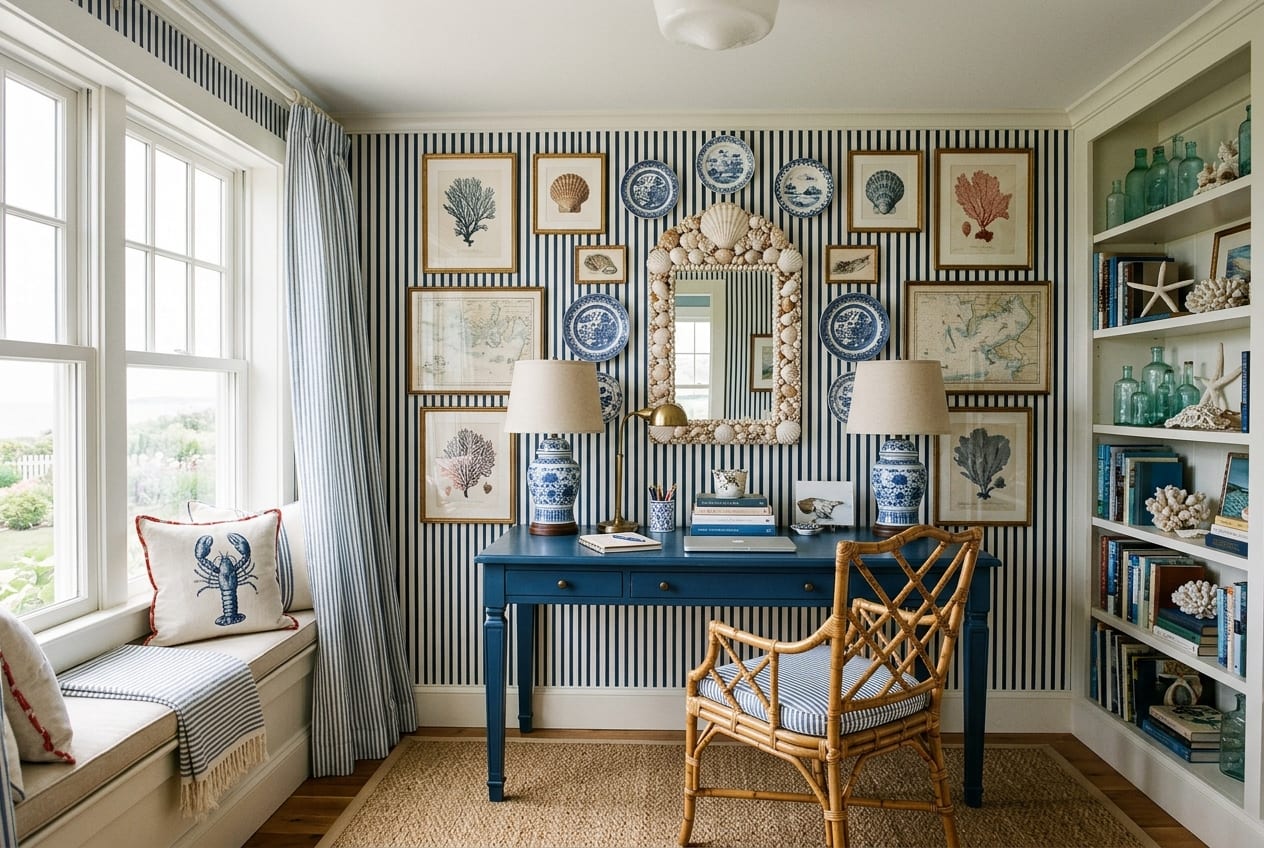
Coastal maximalism is what happens when a New England yacht club collides with a beachcomber's collection and nobody cleans up the beautiful mess. It's navy stripes and coral branches, blue-and-white ceramics stacked three deep, rope and rattan and shells arranged like museum specimens. This isn't the washed-out, all-white coastal minimalism of rental properties—this is the coast with personality, color, pattern, and enough visual interest to keep you awake during video calls.
The look draws from centuries of maritime tradition: British naval uniforms, Chinese export porcelain that sailed the trade routes, Victorian naturalist collections, and the grand coastal estates of Newport and Palm Beach. Sailors brought home treasures from every port; wealthy families summered in houses stuffed with nautical paintings, ship models, and rooms papered in documentary prints of exotic fish. Coastal maximalism honors that collecting instinct without the yacht.
People love it now because it solves the remote work riddle: how do you make a home office feel like work without making it feel like work? Marina gives you structure (those navy stripes don't let you slack off) and vacation (those shells remind you why you're earning a paycheck). It's professional enough for Zoom but personal enough that you actually want to sit there. And it works anywhere—you don't need an ocean view to channel the coast.
The signatures
- Navy and white stripes—on walls, pillows, or rugs—as the organizing principle
- Blue-and-white ceramics displayed in multiples, not hidden in cabinets
- Natural textures: seagrass, rattan, jute, rope, driftwood
- Coral, shells, and sea life as art and objects, not just bathroom accessories
- Nautical references that feel collected, not themed—vintage maps, ship prints, brass telescopes
- Pops of coral, salmon, or warm pink to keep all that blue from feeling cold
Anatomy of the look
Color & Paint
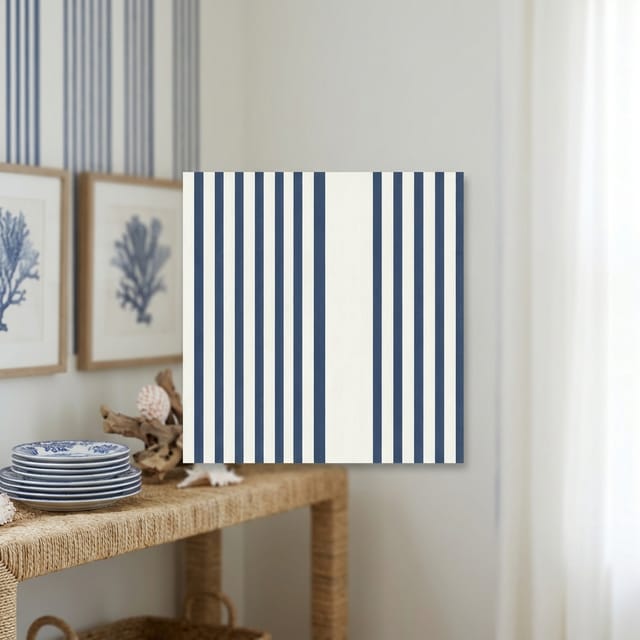
Marina's walls wear navy stripes like a Breton shirt—vertical, crisp, and confident. The pattern does the heavy lifting, so everything else can breathe. Between the stripes, sail white keeps things bright enough for spreadsheets. Coral appears in small, warm doses—prints, a lampshade, a stack of vintage books—so the room doesn't skew icy.
Walls & Pattern
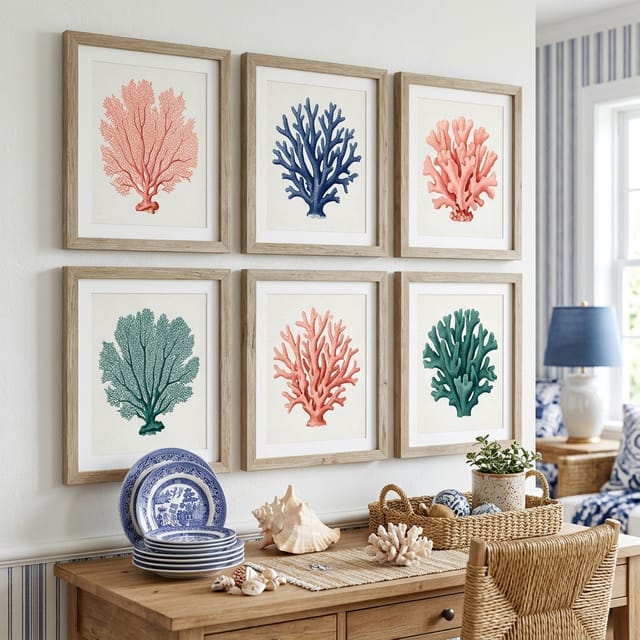
Beyond the stripes, Marina layers in more pattern—never matching, always harmonizing. A vintage nautical chart in a simple frame, a grouping of framed coral specimens, maybe a blue-and-white chinoiserie print. The key is mixing scales: big bold stripes, medium florals or sea life, tiny details in the ceramics. This isn't a gallery wall, it's a curiosity cabinet that happens to be flat.
Furniture & Shapes
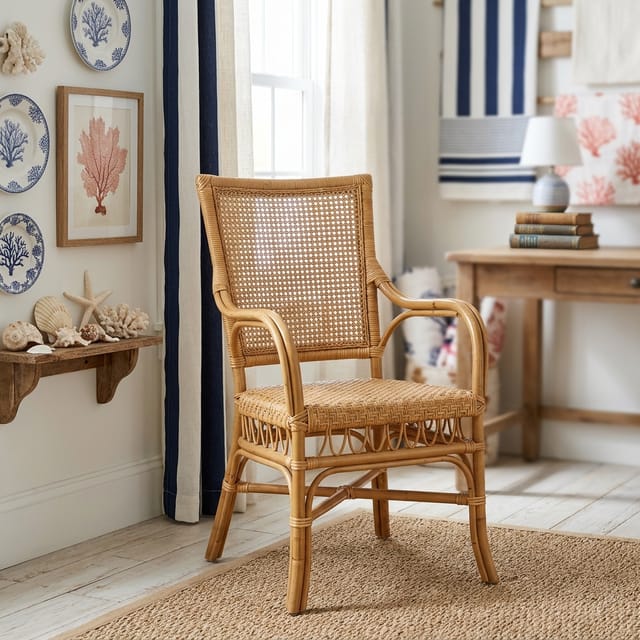
The desk itself is clean-lined—white or natural wood, nothing too ornate—because the room has plenty of personality elsewhere. Pair it with a rattan desk chair that could have come from a 1970s beach house. Add a skirted table (navy stripe fabric, naturally) to hide office supplies or a printer. Furniture here is either sleek or textured, never fussy.
Textiles
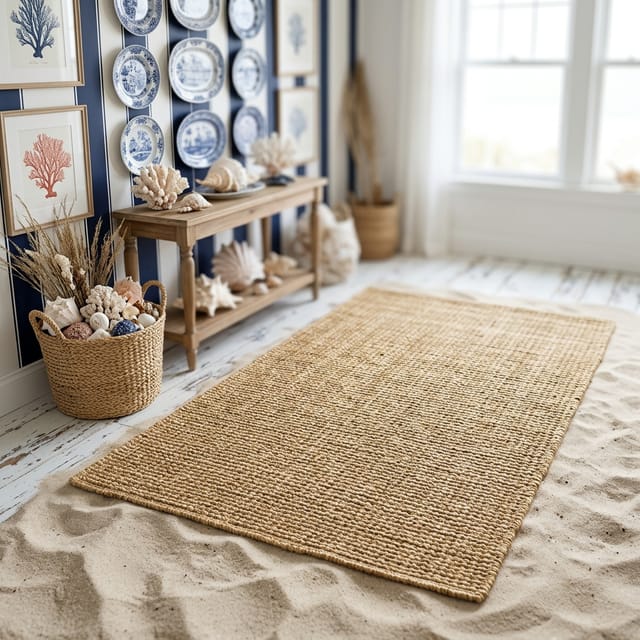
Seagrass underfoot is non-negotiable—it's the texture that makes the whole room smell like summer in your mind. Layer a smaller navy-and-white striped rug on top if you need softness under your desk chair. Linen curtains in white or natural keep the light gentle. A throw pillow or two in coral linen on a reading chair picks up the warmth from the walls.
Lighting
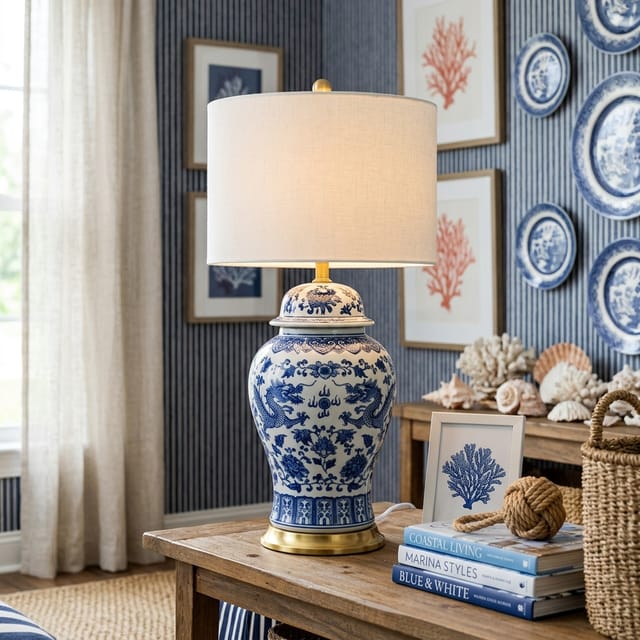
Marina needs a blue-and-white ginger jar lamp on the desk—the kind with a pleated white shade that glows like a lantern. Add a rattan pendant overhead for ambient light, or a brass swing-arm sconce by the reading chair. The goal is layers: task lighting that's pretty enough to photograph, overhead lighting that doesn't feel like an interrogation room.
Collections & Accessories
This is where Marina really comes alive. Shells in glass cloches or shallow bowls. A collection of blue-and-white ginger jars on a shelf, varying heights and patterns. Coral specimens (real or faux) standing in for sculpture. Brass nautical instruments—a compass, a sextant—that actually look good on a bookshelf. Stack vintage hardcovers with ocean-blue spines. Every surface tells a story about something you found, not something you bought in a set.
Plants & Flowers
Marina doesn't do a lot of greenery—this isn't a jungle, it's the coast—but a single statement plant works wonders. A fiddle leaf fig in a blue-and-white planter, or a palm in a woven basket. Fresh flowers in white or coral—peonies, ranunculus, garden roses—arranged loosely in a blue-and-white vase. The plant life here is edited, never overgrown.
The recipe
The Marina Formula
- 160% navy and white—stripes on the biggest surface, then echoed in smaller doses throughout
- 225% natural textures—seagrass, rattan, jute, rope, linen—to keep it from feeling too polished
- 310% coral or warm pink—just enough to make the blues feel sunny, not stormy
- 45% brass or warm metal—for a little shine and a hint of maritime history
Paint picks
Navy Stripe #1C2E5C
Vertical stripes on the main wall behind your desk, paired with white—wallpaper is easier than painting, trust us
Sail White #FFFFFF
The stripes' partner, plus trim, ceiling, and any built-ins—keeps the navy from closing in
Coral #E8836B
Accent wall in a small powder room adjacent to the office, or just in artwork and accessories—a little goes a long way
Seagrass #C9B48A
Not for walls—this is the color of your rug, your curtains, your rattan furniture, the warmth that balances the cool
Room by room
Living Room
Go bigger with the blue-and-white ceramics—a whole wall of plates, ginger jars on every surface, a navy-and-white striped sofa. Add a jute rug, coral pillows, and a driftwood coffee table. This is where coastal maximalism gets to show off.
Bedroom
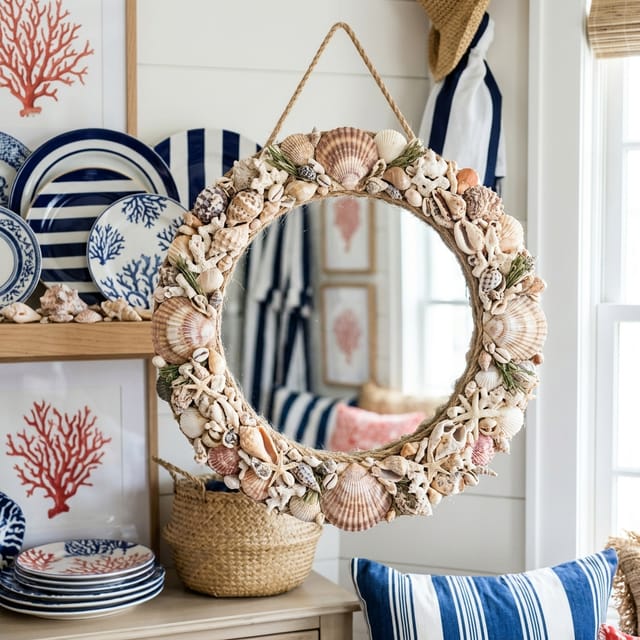
Keep the stripes softer here—maybe just a navy-and-white duvet or a single accent wall. Layer in white linen, seagrass baskets for storage, and coral-pink throws. A shell mirror above the dresser and a rattan pendant overhead make it feel like a boutique hotel on the coast.
Kitchen & Dining
Open shelving stacked with blue-and-white dishes is the move. Add a seagrass runner down the dining table, navy linen napkins, coral-handled flatware. Hang a collection of vintage fish prints or a large nautical chart. Coastal maximalism loves a kitchen that looks used and loved.
Bathroom
Navy subway tile in the shower, white grout, brass fixtures. A shell-encrusted mirror, a seagrass bath mat, coral hand towels. Display shells and coral on a tray by the tub. This is the one room where the coastal theme feels completely natural, so lean in.
Small Spaces & Rentals
If you can't paint stripes, use a navy-and-white striped rug or curtains to set the tone. Lean a large nautical chart against the wall, cluster blue-and-white ceramics on a bookshelf, and add a seagrass basket for storage. Coastal maximalism scales down beautifully—it's about the mix, not the square footage.
Get it on any budget
Under $200
Under $500
Renter-friendly
- Use peel-and-stick navy stripe wallpaper on one accent wall—it comes off cleanly and makes a huge impact without painting
- Lean large-scale art and nautical charts against the wall instead of hanging them—same visual weight, zero holes
- Swap out basic cabinet hardware for brass pulls or rope-wrapped handles—takes five minutes, transforms the room, and you can swap back when you move
- Layer rugs to define the space—a seagrass rug with a smaller navy-and-white striped rug on top hides bad carpet and adds pattern without a lease violation
Easy to avoid
- Going too literal with the nautical theme—you want collected coastal, not a seafood restaurant. Skip the anchor throw pillows and the signs that say 'Seas the Day.'
- Using only cool blues without warm accents—all navy and white can feel stark and cold. Coral, warm wood, seagrass, and brass are what make this livable.
- Matching everything too perfectly—the blue-and-white ceramics should be different patterns, the stripes should appear in different scales. Coastal maximalism is a collection, not a catalog page.
- Forgetting texture—this style lives and dies by natural materials. If everything is smooth and painted, it's just a blue room. You need the seagrass, the rattan, the linen, the rope.
FAQ
What's the difference between coastal maximalism and regular coastal decor?
Regular coastal decor tends to be minimal—whitewashed wood, a few shells, lots of empty space. Coastal maximalism embraces pattern, color, and collections. It's more 'grand seaside estate' than 'beach rental.' You're layering blue-and-white ceramics, coral specimens, vintage maps, and textured textiles instead of keeping things spare and beachy.
Can you do coastal maximalism if you don't live near the ocean?
Absolutely. Coastal maximalism is about a feeling and an aesthetic, not your zip code. The navy stripes, blue-and-white porcelain, and natural textures work anywhere—they just happen to be inspired by maritime history and beach houses. Think of it as bringing the vacation home, not pretending you live somewhere you don't.
How do I keep a navy-striped office from feeling too dark?
Balance is everything. Use vertical stripes (they lift the eye) with plenty of white in between. Keep the ceiling white, add white or natural linen curtains, and make sure you have good lighting—both natural and layered artificial light. The seagrass rug and warm coral accents also prevent the room from skewing too cool or cave-like.
Where can I find blue-and-white ceramics without spending a fortune?
Start with thrift stores, estate sales, and online marketplaces—vintage ginger jars and plates are everywhere once you start looking. You can also find affordable new versions at home goods stores. Mix high and low, old and new. The beauty of a collection is that it builds over time, and the mismatched patterns actually look better together.
What if I want coastal maximalism but I'm not into blue and white?
You can absolutely shift the palette. Try green and white (more Palm Beach), coral and white (more tropical), or even black and white with natural textures (more modern coastal). The principles stay the same—stripes, pattern, natural materials, collected objects—but you're not locked into navy. Coastal maximalism is a structure, not a single color story.
Some links may earn MAX by Design a small commission at no cost to you.