The Style Guide · Chinoiserie
Chinoiserie Maximalism: How to Get Ravi's Hand-Painted Look
Ravi proves that more patterns mean more stories, and in chinoiserie maximalism, every surface is an invitation to look closer.
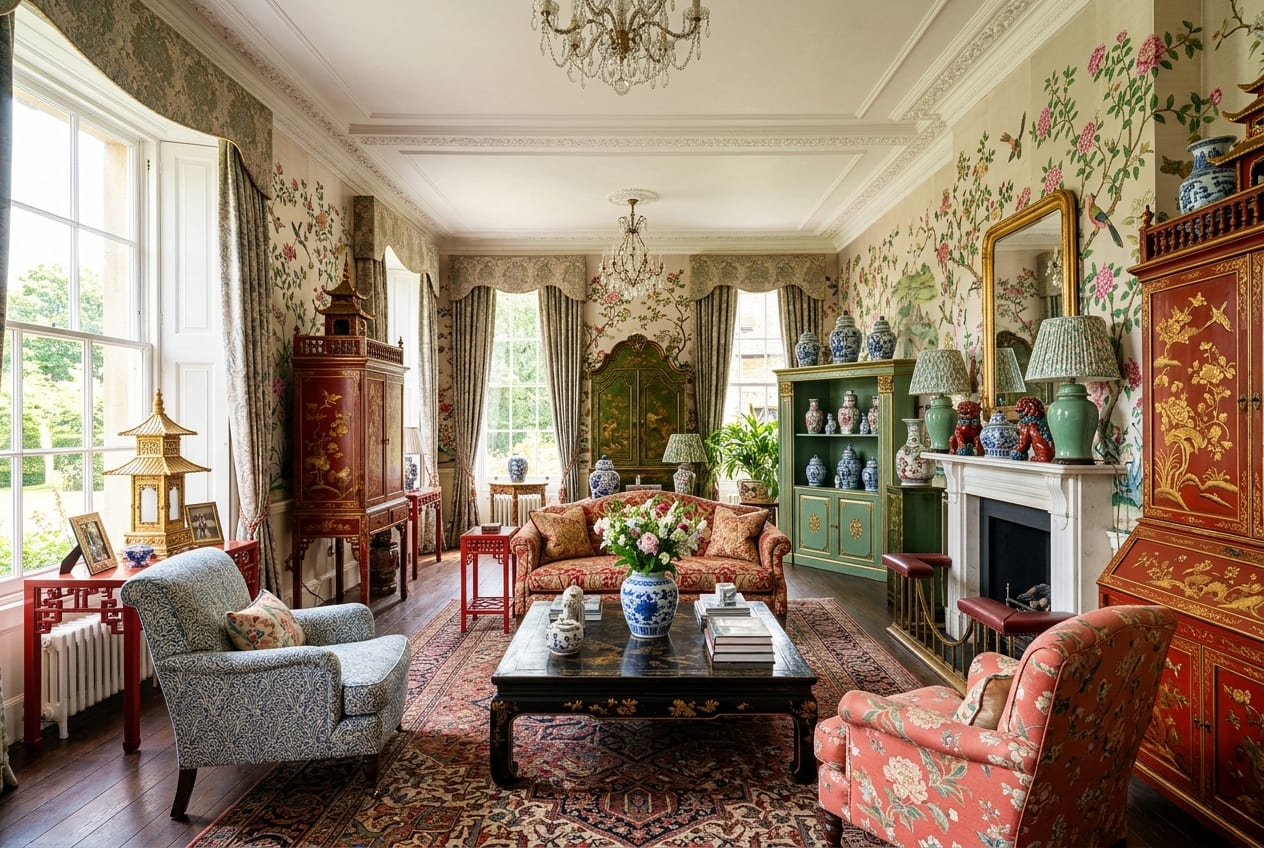
What is Hand-Painted Chinoiserie Maximalism?
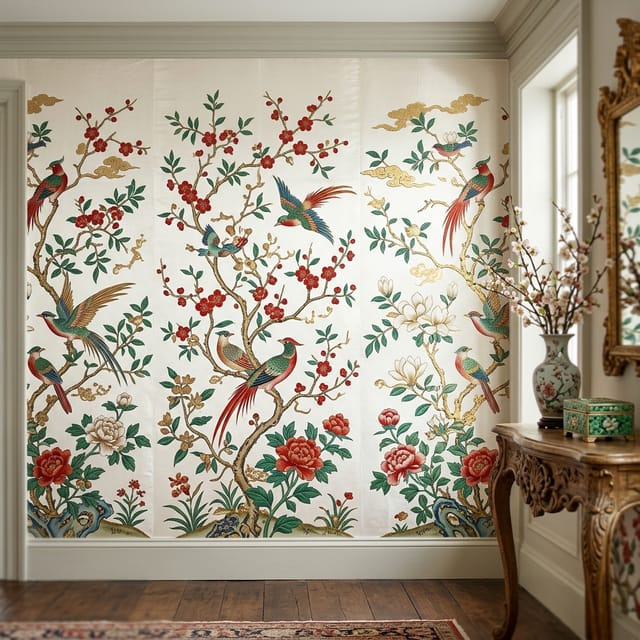
Chinoiserie maximalism is the art of layering European interpretations of Asian aesthetics until the room hums with narrative energy. Ravi's version centers on hand-painted or hand-gilt details—pagodas climbing up wallpaper, dragons coiling around porcelain, birds mid-flight on silk panels. The palette stays disciplined even as the pattern count climbs: jade green and imperial red against a luminous silk-colored ground, with gold leaf catching light like punctuation marks. This isn't about authentic reproduction; it's about the joyful conversation between 18th-century European fantasy and genuine admiration for Eastern craft traditions.
Chinoiserie emerged in the 1600s when European aristocrats became obsessed with imported Chinese and Japanese goods they could barely afford and often couldn't obtain. So they invented their own versions—wilder, more theatrical, unbound by the restraint of actual Asian design. French and English craftsmen painted fanciful scenes of pagodas, impossible birds, and gardens that never existed, creating a hybrid style that was pure imagination. By the 1700s, entire rooms were wrapped in hand-painted chinoiserie panels, and porcelain collecting became competitive sport. Today's maximalist revival loves chinoiserie for the same reason the original fans did: it gives permission to pile on pattern and call it curation.
What makes people fall for Ravi's approach now is how it solves the maximalist's eternal dilemma—how do you add more without creating chaos? Chinoiserie provides a visual language that's already ornate, already layered, already telling stories. When everything shares a common vocabulary of pagodas, peonies, and phoenixes, you can mix six patterns in one sightline and it reads as intentional rather than accidental. It's maximalism with a built-in organizing principle, and it rewards the kind of person who'd rather have too much beauty than risk having too little.
The signatures
- Hand-painted or hand-gilt wallpaper as the room's narrative backbone
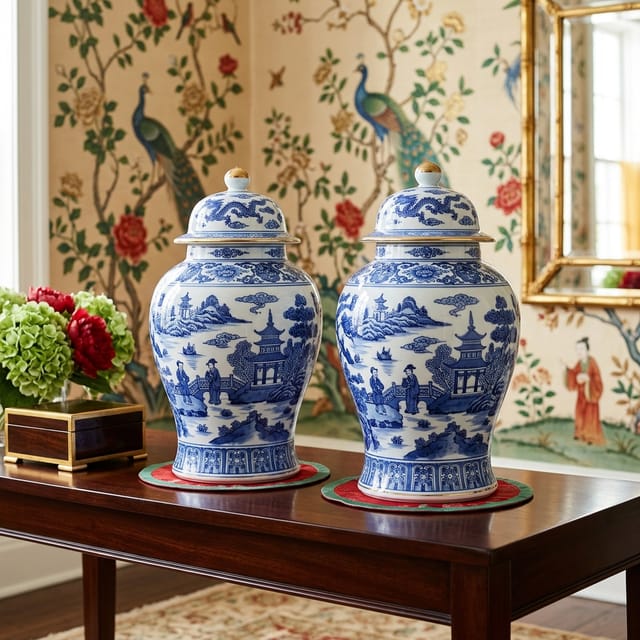
- Blue and white porcelain in multiples, never alone
- Jade green and imperial red in constant conversation
- Fretwork and latticework adding geometric counterpoint to organic patterns
- Silk textiles with embroidered or painted scenes
- Gold accents applied like brushstrokes, not floods
Anatomy of the look
Color & Paint
Ravi's palette is a three-way negotiation between cool jade, hot imperial red, and the silk ground that keeps both honest. The walls stay light—that luminous cream that good silk has before it yellows—so the hand-painted panels and porcelain collections can pop forward. Gold appears as accent, not base coat, mimicking the way gilt details catch light on antique panels.
Walls & Pattern
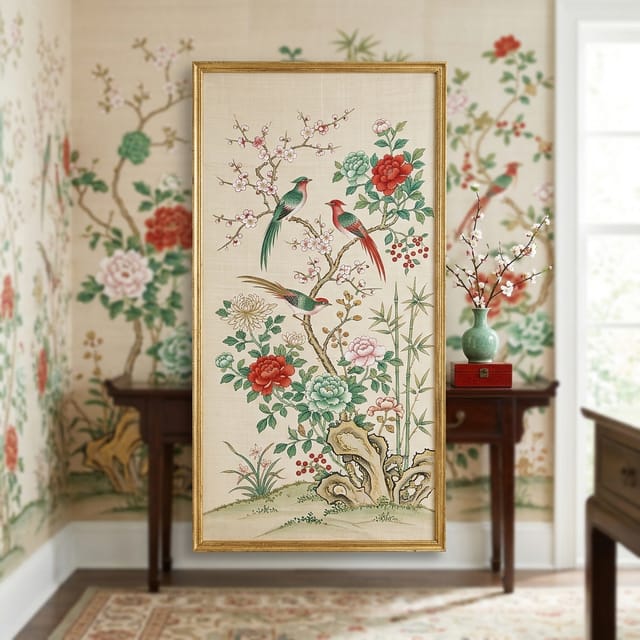
This is where Ravi makes his boldest move—wallpaper with hand-painted chinoiserie scenes, or large-scale panels that read as art and architecture simultaneously. If budget or rental restrictions apply, he'd choose one statement wall and frame smaller panels elsewhere. The key is that the pattern tells a story you can follow: a bird flies from one corner toward a branch in another, a bridge leads somewhere even if that somewhere is just more wallpaper.
Furniture & Shapes
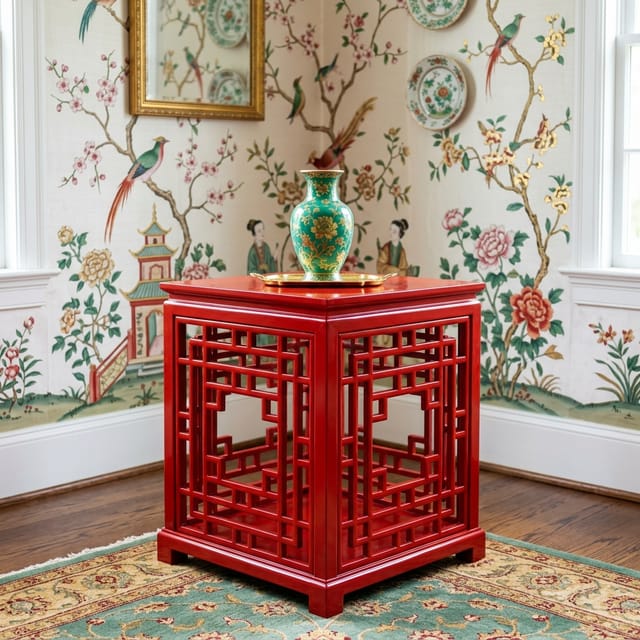
Furniture in Ravi's world provides geometric relief from all that organic pattern—fretwork side tables, lattice-back chairs, bamboo-turned legs that echo the straight lines in the wallpaper's pagodas. He loves a lacquered cabinet in glossy black or deep red, surfaces that reflect light and pattern back into the room. Curves appear in the furniture's decorative details but the overall silhouettes stay crisp.
Textiles
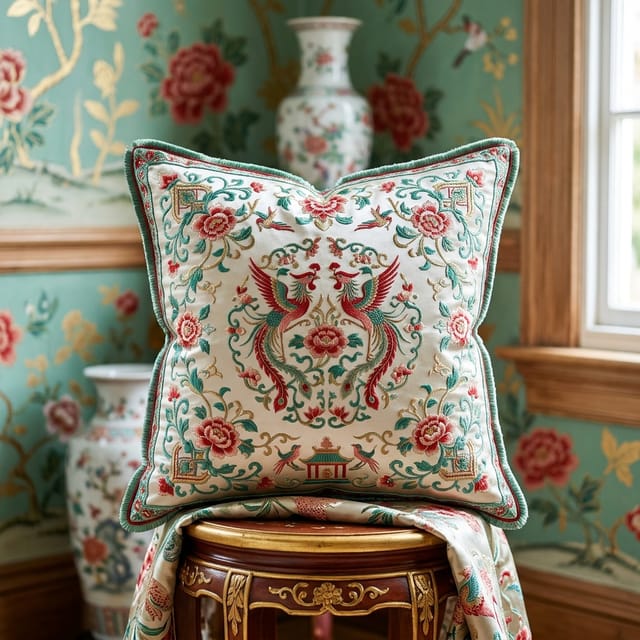
Silk is the textile backbone here—embroidered cushions with peonies and phoenixes, throws with hand-painted scenes that continue the wallpaper's narrative. Ravi layers patterns on patterns but keeps the material quality consistent: everything should have a slight sheen, a whisper of luxury. Even cotton gets dressed up with embroidered details or block-printed chinoiserie motifs.
Lighting
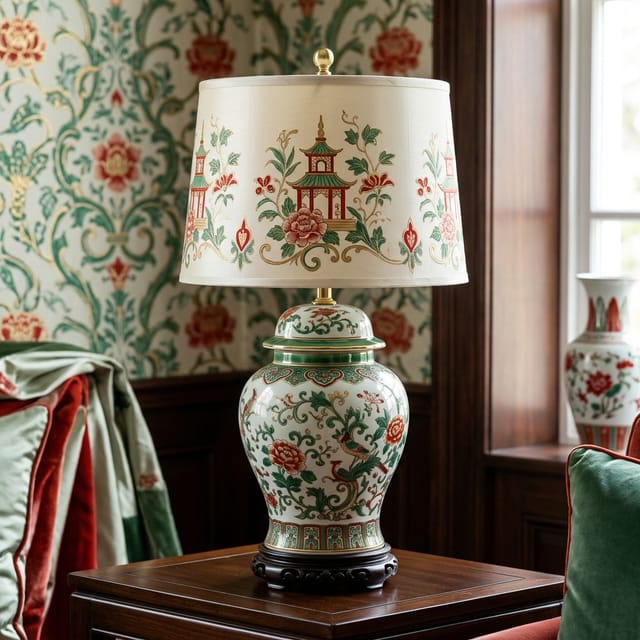
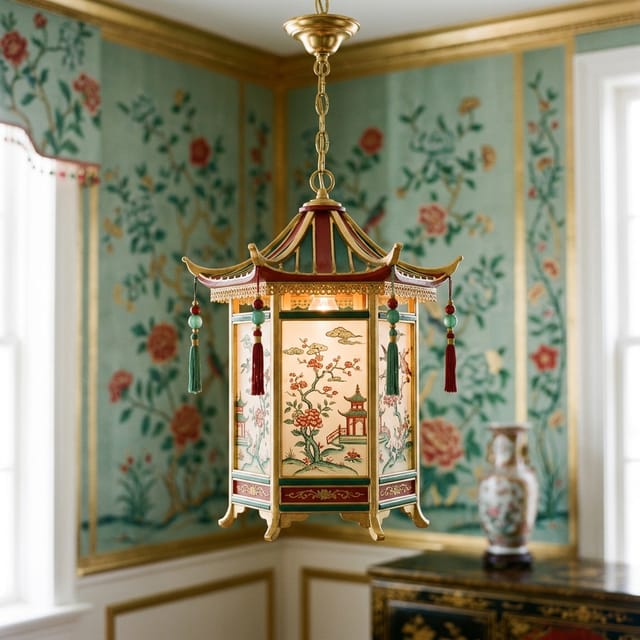
Lighting in a chinoiserie room should look like it could have existed in 1750, even if it's wired for 2025. Pagoda lanterns, ginger jar lamps with silk shades, sconces with fretwork shadows. Ravi wants light that enhances the hand-painted details rather than washing them out, so he layers sources—table lamps for pools of warmth, overhead fixtures for drama.
Collections & Accessories
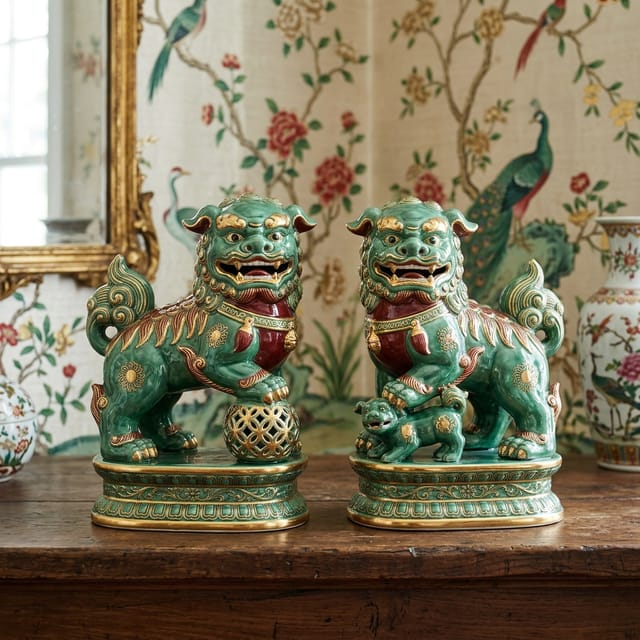
Here's where Ravi's maximalism really announces itself—collections of blue and white porcelain on every surface, foo dogs guarding doorways and shelves, decorative boxes with hand-painted lids stacked like a visual essay on pattern. He groups like with like (all the ginger jars together, all the foo dogs in conversation) but mixes scales wildly. One enormous vase anchors a collection of six tiny ones.
Plants & Flowers
Ravi loves plants that echo the ones in his wallpaper—orchids, peonies when in season, branches of cherry blossom (real or very good fakes). He arranges them in more blue and white porcelain, naturally, and isn't afraid of sculptural arrangements that look slightly formal. A single dramatic branch in a tall vase can hold its own against all that pattern.
The recipe
The Ravi Formula
- 160% luminous silk-ground neutral (walls, larger furniture, ceiling) to let the pattern breathe
- 225% jade green and imperial red split between them, always in conversation across the room
- 310% blue and white porcelain as the collecting obsession that ties everything together
- 45% hand-gilt gold as the punctuation—on frames, lamp bases, furniture details, never as a flood
Paint picks
Silk Ground #F3ECD9
Walls, ceiling, and any large furniture piece that needs to recede—this is the luminous backdrop that makes everything else possible
Jade #1F6B5C
Accent wall behind a collection, inside of a bookcase, or on a statement piece of furniture—the cool jewel tone that balances the red
Imperial Red #B22222
Lacquered cabinet, back of open shelving, or as the color for one dramatic piece of furniture—the heat that makes jade look cooler
Hand Gilt #C9A227
Picture frame interiors, lamp bases, furniture hardware, hand-painted details on walls—applied like brushstrokes, catching light strategically
Room by room
Living Room
Make the sofa wall your chinoiserie moment with hand-painted panels or bold wallpaper, then echo the pattern in smaller doses on cushions and a pair of ginger jar lamps. Cluster your blue and white collection on one large bookcase or console rather than scattering it—Ravi believes in the power of multiples.
Bedroom
Let the bed wall carry the pattern weight with framed chinoiserie panels or wallpaper, then keep the bedding itself slightly quieter in silk-ground cream with embroidered details. A pair of foo dogs on the nightstands and a pagoda pendant overhead complete the story without overwhelming the space you're trying to sleep in.
Kitchen & Dining
If you can't wallpaper, Ravi would collect blue and white serving pieces and display them on open shelving or a plate rail—instant chinoiserie without commitment. A fretwork room divider or lattice cabinet doors add the geometric pattern that balances organic motifs, and silk napkins with embroidered details make every meal feel like an event.
Bathroom
One wall of chinoiserie wallpaper (the one you face from the tub) transforms the smallest room into a jewel box. Add a collection of small blue and white vessels for cotton balls and soap, a fretwork mirror frame, and suddenly your bathroom has more personality than most people's living rooms.
Small Spaces & Rentals
Removable chinoiserie wallpaper on one wall makes a huge impact without the commitment, and you can create Ravi's layered look with a single large framed panel plus a collection of three to five blue and white pieces on a small shelf. Silk cushions and a ginger jar lamp add pattern without taking up precious square footage.
Get it on any budget
Under $200
Under $500
Renter-friendly
- Use removable chinoiserie wallpaper on one accent wall—it peels off cleanly and creates the hand-painted look without the commitment or the landlord conversation
- Build your pattern through textiles and collections instead of permanent changes—silk cushions, embroidered throws, and a growing collection of blue and white porcelain can be packed up and moved to your next space
- Lean large framed chinoiserie panels against walls rather than hanging them, or use picture-hanging strips rated for the weight—you get the impact without the nail holes
- Choose furniture with built-in chinoiserie details like fretwork side tables or lattice-back chairs rather than trying to alter plain pieces—the pattern comes with you when you move
Easy to avoid
- Spreading blue and white pieces one per surface instead of collecting them in groups—Ravi knows that three ginger jars together tell a better story than three ginger jars in three different rooms
- Choosing only cool tones and wondering why the room feels flat—you need that imperial red heat to make the jade green really sing, even if it's just in cushions and small accessories
- Matching every pattern's scale exactly, which creates visual static instead of visual interest—mix a large wallpaper pattern with medium embroidered textiles and small porcelain details for depth
- Forgetting that negative space isn't the enemy, it's the pause between stories—even Ravi leaves some silk-ground breathing room so your eye knows where to rest before the next pattern begins
FAQ
Is chinoiserie cultural appropriation?
Chinoiserie is a European fantasy style that was never meant to accurately represent Asian cultures—it's 18th-century Europeans imagining an exotic elsewhere they'd never seen. Today, it's worth acknowledging that history while enjoying the pattern and craft. If you're drawn to authentic Asian design traditions, research and invest in actual Chinese, Japanese, or other Asian artists and craftspeople rather than the European interpretation. Ravi's approach celebrates the pattern language while being honest about its origins.
How do I mix chinoiserie patterns without creating chaos?
Keep your palette tight even as your pattern count climbs—Ravi sticks to jade, imperial red, blue and white, and gold on that silk ground, which means six different patterns still read as a family. Vary the scale (large wallpaper, medium textiles, small porcelain details) and repeat motifs across different surfaces—if your wallpaper has pagodas, echo that shape in a lamp or side table. Pattern mixing works when there's a common visual vocabulary.
Can I do chinoiserie maximalism in a small space?
Absolutely—small spaces actually benefit from Ravi's approach because the pattern gives your eye so much to explore that the room feels larger than its square footage. Focus on one wall of chinoiserie wallpaper, add a collection of blue and white pieces on open shelving, and layer in textiles with embroidered details. The key is committing to the look rather than doing it halfway—a timid approach to maximalism just looks cluttered.
What if I can't afford hand-painted wallpaper?
Ravi would tell you that printed wallpaper with a hand-painted look is perfectly fine—what matters is the pattern and the story it tells, not whether someone actually painted it by hand. You can also create the effect with large framed prints of chinoiserie panels, which you can find as affordable reproductions. Focus your budget on one or two statement pieces and build the rest of the look with textiles and collected porcelain.
How much gold is too much gold in a chinoiserie room?
If more than 5% of what you see is gold, you've crossed from gilt accent into gilt overload. Ravi uses gold like a calligrapher uses ink—deliberate strokes that guide the eye and catch the light, not a flood that overwhelms everything else. Gold should appear on frames, lamp bases, furniture hardware, and small decorative details, always in conversation with the jade, red, and blue rather than trying to outshout them. When in doubt, add one more blue and white piece instead of one more gold one.
Some links may earn MAX by Design a small commission at no cost to you.